Wednesday, 6 February 2019

Leaking flush valve

Almost since I moved into my house I have had a slight leak from the flush valve on my toilet in my en-suite bathroom. It is not your normal loo with a cistern attached, but rather the sort you would normally expect to find in a public building, with a "button" on the wall connected to the water supply (in my case a 1500 litre roof-mounter water tank). You press the button and a measured amount (you can adjust it easily) of water flushes your toilet - the main advantage being that there is no wait for the cistern to fill, but you can keep flushing - ideal in, say, an airport toilet, or even an office toilet where there are multiple staff members using the toilet regularly.
The leak initially collected behind the button cover plate, and seeped into the wall, but I removed the plate and placed it in a drawer in my bedroom, and then the leak simply dripped down in front of the wall tiles, doing no damage.
As it is non-standard I have struggled to find a repair kit for this. The first I bought was a different brand, and the wrong size, but eventually I found the correct one, though it needed a specialised tool to remove the front plate - a 24mm box spanner. I could find a 25mm, but not the 24, so the leak remained for months, with an empty ice-cream container catching the dripping water. It was not major so I didn't worry too much about it, but whenever I went to the city I would try some hardware stores to see if they had the correct spanner, and even looked there during my trips to Peru.
I finally managed to get one in the UK, where I had not been for over 2 years, and took that to Peru before returning to my house in Brazil.

Repair kit
As can be seen the instructions for the repair kit (which, in the photo is sitting on top of a sheet of A4 paper) are minuscule, and consisted mainly of an exploded view of the system, while the kit comes ready assembled! It looked as though I had to turn the water from the 1500 litre tank off first, and since this was outside and only accessible using a ladder, I had put this off for a long time! However the leak appeared to be getting worse, and I decided I needed to get myself organised and effect the repair.
Since there are so many "how-to" videos on YouTube I decided to start there, so entered the details into their search box and up came a long list of solutions. The first one looked promising, but it was filmed using a mobile phone, which he set up on the sink about 2 metres from the valve location - and you could see nothing of what he was doing! He kept bringing pieces close to the phone, but they went out of focus, or he held them in such a way the camera didn't pick them up ... and this was the "top pick" most viewed solution!
The next two were no better - both were done by "plumbers" but they were working on a complete brand-new valve, on a worktop not installed in a working location, so basically were pretty useless. It is one thing to work on a "dry" valve, and another to work on something hooked up to the water supply - but both also claimed you had to turn the water supply off first!
I was about to give up watching and get straight to work when I noticed a clip by the manufacturer!!! Why it is not the number 1 clip I have no idea, but it was professionally done, covered several different scenarios, including if there was still a leak after you installed the kit and possible causes, and, best of all, showed that you didn't have to turn the water supply off first, but simply had to screw the valve in tight first which cut the water off!
So armed with this knowledge this morning I easily completed the work - well, removing the 24mm bolt took some effort as it was incredibly tight, and also when I removed the nipple and washer (top left in my photo) I found evidence of an earlier attempt at a repair, which appeared to consist of packed the area beneath the nipple with something like Blu-tack! Removing the complete old assembly (replacement one shown bottom right of the photo) was also not that easy, and took several attempts using levers and spanners to ease it out without damaging the old one. Put everything together, adjusted the water volume and ... no leak.
Final part of the job was to replace the cover plate and button, which were in my top drawer ... or not! They were in the second drawer, or rather the plate and screws, but not the button were! I searched high and low, including other parts of the house where the button had no reason to be - and then realisation dawned on me ... these had been moved by my rogue house-sitter in 2017, who had gone through all my stuff, and chances are that he had no idea what the plastic button was and may even have disposed of it, but whatever the reason I now have to try and get a new button to complete the repair. At least it doesn't leak any more!

Sunday, 20 January 2019

Workmanship

I am not sure when I first became interested in DIY (do it yourself), though I do recall that my father was an avid gardener, and also used to do some basic tasks around the house. My early years were spent either sharing a house with my grandparents, or in rented accommodation, so my family didn't own a house until 1963, when I was 10, and as it was a new build it didn't need much doing to it, though my dad did build me a wardrobe in my bedroom, on the plinth that jutted into my bedroom to give headroom for the stairs!
I am not sure of the exact dates but I know at some stage he bought the Reader's Digest Do-it-yourself manual, which as well as hints and tips for DIY-ers, also had a section on simple projects for the home. I was an avid reader so used to dip into this from time to time, and enjoyed the step-by-step instructions the massive book contained. Years later I bought one for myself, amongst other DIY books, and it became my "bible" for any work I wanted to do. Back then we did not have the luxury of the internet, and endless "how-to" (and "how-not-to"!!) videos on YouTube, nor numerous sites that gave instructions how to do basic tasks around the home, so we had to rely on books if we wanted to do the work ourselves.
Back then, too, specialist tools were not available to the home handyman, or the price was so prohibitive that it was not worth buying something that might only be used for one job. Now the market is flooded with cheap imports (dare I say, mainly from China) and I, along with many others, had a pretty well equipped toolbox, not the best quality, and probably not good enough if you were a serious tradesman, but adequate for occasional basic projects. There are now, at least in the UK, a myriad of Hire Shops, where you can rent specialist equipment for those occasions when your own tools are inadequate. For example, I have in the past hired a floor sander to smooth off old parquet flooring.
But I am getting ahead of myself. By 1976 (when I was 23) I still hadn't really done any DIY, but during a study break from work, when I stayed with some friends near Pietermaritzburg, in South Africa, I helped out with the construction of a concrete shower enclosure in their bathroom. I worked on some of the pipework, and a little of the concreting, and seemed to do OK at it.
Upon my return to the UK in 1978 I joined the family grocery business, and in 1979 we decided to open a bakery in the adjoining property (which we owned but had previously rented to a hairdresser). To convert the shop we needed quite a bit of work to be done, so called in a local builder, who we knew, for a quotation. We needed two sinks installing, a water heater, suitable flooring laying (over floorboards), a 3 metre long work bench with shelving beneath, walls painting, and shelving built in a store-room. He came in took a load of measurements and the following day called back with his quotation - £10,000!! This was more than double the price we were expecting, and in 1979 was very expensive for a fairly simple job for a qualified builder. We got the impression he didn't really want such a small (for him) job, as he was in much demand for house building, so was "trying it on". We rejected his quote and turned to the newspaper adverts, where we came across a man offering his services for "renovations and small building projects", so gave him a call (remember no internet back in those days!). He again took some measurements, and made some notes, but before leaving told us "this job is really too big for me"!
At this stage I decided I would try and do most of the work myself. We needed to have three-phase power installed by the Electricity Board, and they offered to install the water heater (over the sink) at the same time, for little more than the cost of the heater - we just had to chisel out an entry hole for the 3-phase cabling under the exterior wall (which was not as easy as it sounds as the house was over 100 years old and there was a lot of very hard flint to chisel through) and the rest of the installation was free!
(Full details about the bakery are in a separate post Opening a bakery)
We got a company to lay industrial grade flooring over the floorboards, which again was fairly cheap, and I started sourcing the other materials we would need. I bought a pair of stainless steel single drainer sinks (left and right) from a local DIY store, which were on clearance and cost £25 for the pair! I drew up plans for the workbench and calculated how much timber I needed and went to a local timber merchant. When he saw the quantities he asked what it was for, and then offered me 35% trade discount! He also gave me a lot of advice about how to go about doing the job, and suggested some alternatives to those I was planning to use, in all saving me a lot of money.
We painted the walls ourselves, using gloss on the walls in the main bakery area and emulsion on the ceiling, and in the "display" area, and this was a big mistake! The levels of condensation produced by the heat and steam in the bakery soon produced mould spores, and no amount of cleaning would prevent this. Through a trade publication we contacted a specialist paint company, and bought two different types of very expensive specialist paint, but after applying these we never had the problems again!
I also plumbed in the two sinks, having first built a bench to hold them, with shelves underneath, and there were no leaks!
My dad already owned an electric drill, screwdrivers and chisels, and we did buy a mitre joint set, though this was used with hand saws to create all the joints, and by the end of the work I had blisters from screwing the hundreds of countersunk screws manually (realised as I neared the end that we could have bought a cordless screwdriver!)!
The finished product looked amazing, if I say so myself, and soon we were ready to start baking. Aside from my labour cost - I did most of it myself as my dad was working in the grocery shop next door - the total cost of all the materials, the water heater, flooring, paint, etc. came to under £2500, and took under a month to complete. The work had been challenging, though early on I realised that nothing had really been beyond my abilities, and this new-found confidence led me to attempt other projects in the future. Previously I hadn't considered myself to be very adept at manual tasks like this, but as the work progressed I soon came to the realisation that often you restrict yourself in what you do, or even attempt, by not even trying to challenge your abilities!
With my new-found confidence over the years I attempted even more challenging projects, the most satisfying one being installing an en-suite bathroom! We lived in a Dormer Bungalow (a bungalow that has had a second storey added in the eaves) and the bathroom was downstairs with three bedrooms upstairs (and a fourth downstairs which we converted into a workroom for my wife who ran a cake making business from home). 
The master bedroom was large enough to accommodate a good-sized bathroom, but we didn't have the money for the conversion, though over several years we bought bits and pieces for it when we found them on offer, so matching sink and toilet, shower enclosure, and even tiles were bought and stored away. Finally we decided we had saved enough to make a start, but the big concern was how to get rid of the waste. Our bedroom had a sink in it already in the corner, which had a drain pipe, but this was only around 5cm, so unsuitable for a toilet. We were unsure how to proceed so realised that here we needed expert advice so called in a plumber, with the intention that he would do the plumbing work for us. He wanted to cut channels in the joists to run the waste pipes, and was talking of having to install reinforcements (as the joists were load bearing!) and his quote, just for the plumbing work was more than our total budget! We declined the offer!
Just through the wall from where the en-suite was to be there was a small loft space (housing our central heating header tank also), though it had very restricted headroom, meaning it was more a crawl space, and this was where the electrics were going to come from, as well as where the new water pipes were going to be run. On the outside wall of the house adjacent to this was the vent pipe from the domestic sewer, and this was a 20mm pipe, and during my research I had read that is was perfectly acceptable to join a toilet waste into this, so a new plan started forming - connect the shower and sink to the old sink waste, but the toilet waste would run through the crawl space and into the vent pipe - the biggest worry being whether there would be sufficient "fall" for the waste to run away. The measurements indicated it was just about adequate - without making any further structural alterations - so we went for it!
I am a planner - which means that before undertaking any project I make lots of drawings, take copious measurements, and try to consider all eventualities, and then get all the materials in before I start, so I don't find myself in the embarrassing situation of, say, having cut the electric off and not have the necessary materials to reconnect, and it being Sunday with the shops closed! My wife found that a bit frustrating, as she wanted to jump in and get started, but over the years realised that my way was ultimately quicker and more efficient, as once started we could just crack on until the job was finished! She was also a keen DIY-er so we did much of the work together - she was a dab hand at tiling - and in the end completed it all ourselves, including plumbing and electrical work (nowadays you have to be a certified electrician to do electrics, but since my handiwork is still going strong around 25 years later it bears testament to the workmanship!), and came in well within budget, and only one or two minor problems along the way. One of these was a leaking joint, which took many attempts to resolve, and the second - well, I had a rush of blood to the head while installing the electrics! We were installing three wall lights, as well as an electric shower which got its own wiring and a new circuit breaker, and the idea was that two lights would be linked and the third - over the sink - independent. I planned all the wiring and started running it to the fittings and the switches - to the fittings through the stud wall behind, and to the switches hidden under the coving we were going to attack between wall and ceiling. So I ran the wires to all the locations they were needed, and then we fixed the coving - leaving the electrics to be completed later. When I came to connect the wiring to the switches I had my "moment" - despite all my careful planning beforehand I suddenly though that I could bypass one of the wires I had laid, so removed it and connected the rest up - and flicked the switch! The lights came on - the single one worked fine, but the two linked ones? They came on nice and bright, but when you went to switch them off they just went dim! I realised immediately that I did, after all, need the second wire, which I had pulled out from under the coving, as per my original drawing! Fortunately I managed to replace the wire with the only "damage" being a small square cut into the outside (bedroom-side) stud wall to feed the wire back through, and this was then taped back in place, and wallpapered over (we had not yet done that final piece of the project), and you would never have known there had been a problem!
Now that I am getting older, so am not as physically able as I once was I tend to employ local "craftsmen" to do jobs for me - like exterior house painting, floor tiling, etc. but here in rural Brazil it is very frustrating since most "tradesmen" have no formal training or experience, and the quality of their workmanship leaves a lot to be desired. Paint splashes everywhere - on the floor tiles, across light switches - and even roller strokes on the ceiling where they have over-run, and no attempt to clean up. Irregular gaps between tiles, poorly applied grout, and I have twice had to show "experts" how to measure and cut edge tiles. In many cases, too, I have had to supply the tools as well as the materials - here a "quotation" is just for the labour, you are given a list of what materials are needed, and usually end up with plenty of spares for the next project! In almost all cases I have more experience, and certainly more skill at the work I am paying for, and spend a lot of time "showing " them the right way to do it, but no longer the physical capability, and outdoors no tolerance to the heat and sun.
I am currently waiting for my "man" to finish repainting my two wrought-iron (not as fancy as that sounds!) gates - I supplied him with a wire brush, sandpaper (for metal), paintbrushes, thinners, primer and enamel paint. It took him 3 days - working around 2 hours a day - to prepare and prime the gates, then I didn't see him for 4 days. He then appeared asking if I had any more work for him - so I pointed out the gates needed painting as he had only primed them (he didn't seem to realise that "primer" was an undercoat!), so he spent 2 more hours painting one of the gates - and then disappeared again! It is now 8 days later and he still hasn't returned to top-coat the other gate! Here you have to take what you can get - or suck it up and do it all yourself!

Saturday, 19 January 2019

Going home from Angola

In 1963 my father's three year contract in Luanda, Angola, was up, and though he was offered an extension (and expat terms were very good, as the salary included housing, and schooling costs) it was decided that we would return to the UK. My sister would be 12 later that year and higher education for foreigners meant boarding school in Rhodesia, something that some of the other expats did, but my parents were reluctant to send their daughter to another country for 9 months of the year!
Dad had been offered a very good job back in England with the company he worked for, so we booked a passage by sea back to the UK. We had travelled out in 1960 on a small passenger liner called the Thysville, but our return was to be on an even smaller tramp steamer, the SS Vikaren, which only had 6 passenger cabins, being primarily a freight ship. Tramp steamers are so called as they do not have a fixed schedule, though this one plied the route between Holland and Angola, but varied the stopping ports depending on the cargo.
The SS Vikaren at anchor
When we boarded in Luanda there was another couple on board already, but they disembarked at our first stop, Lobito (also in Angola), so from then on we were the only passengers on board. The ship was Swedish registered and most of the senior crew were Swedish, and with my Mum being Danish she was able to easily converse with them, and once the other passengers left we were invited to dine with the officers from then on. The ship had a small saloon with easy chairs and a record player, and I recall that Doris Day was one of the few English language records.
The main cargo was some kind of animal feed destined for Freetown, in Sierra Leone, but we did stop off at some other places on the way to unload cargo, and our first destination was São Tomé, a small Portuguese island off the coast of Gabon.


The ship anchored offshore 

Being a Portuguese territory we had no problems with language and booked a taxi to take us a short tour of the island.


Central São Tomé, I think

Washing day

Waterfall on the island - taxi guide on the right!
We were only moored for a day or so, then set off again towards Freetown, Sierra Leone, where the majority of the cargo - and, we found later, most of the sailors - were being "unloaded". As it was not a passenger liner there was not a lot to do on board, no organised entertainment (though they did occasionally raise a cargo hatch cover at night and project a film onto this makeshift "screen"), no pool, and so on, but as long as I was careful I was allowed pretty much carte blanche to wander wherever I wanted, and soon came across a group of sailors painting the deck. Apparently each voyage between ports, when there was not much for the deck crew to do, they did some maintenance, and it wasn't long before I was jokingly handed a paint brush and invited to join in - the officer in charge had no objection, and from then until Freetown as soon as I finished breakfast I would go and find the crew and help with the painting!! It made a strange sight - a small (9 year old) English boy working alongside burly African sailors, but I persevered almost every day until lunchtime! When they were being paid off in Freetown, receiving bags of rice, flour and salt as well as their final pay, they spotted me standing with my family - Dad was taking some photos - and they shouted to the quartermaster that he should pay me too for the work I had done!
Unloading in Freetown, and loading a new cargo

Berthed in Freetown
Drop net fishing in Freetown
We had noticed a lot of small fish milling around the docks in Freetown, and mentioned it to one of the officers as I was interested in seeing if we could do some fishing, so he dispatched one of the cooks with a drop net, and we caught a lot of small fish, which were then cooked for dinner later!
I had my 10th birthday on board, which I thought would be a very quiet affair as we were the only passengers, but we had a small party thrown by the officers and I received a few gifts, the only one I recall being a stamp catalogue (the Swedish equivalent of Stanley Gibbons!) by the Radio Officer (Sparky!), who was also a stamp collector and we had spent some pleasant hours discussing our collections! It was obviously in Swedish, which I didn't understand, but had a lot of detail about what to look for in "rarer" stamps (missing watermarks or perforations, design not straight, etc.) so was very useful.
Our next - and final stop before Rotterdam - was Dakar, the capital of Senegal - where some more cargo was unloaded. We again anchored offshore and the cargo, and us, was ferried ashore.

Approaching Dakar 

Cargo being taken ashore by barge and tug
Locals paddled out on canoes to sell produce
 As in many ports throughout the world as soon as you anchored or moored a flotilla of canoes would appear and mill round trying to sell, primarily, fresh produce, but here it was mainly souvenirs and local craft goods. They would throw up a rope with a basket attached and you would pull it up, inspect the contents and then haggle over a price - if you were happy you returned the empty basket with your payment in it!! The prices were, to me, ridiculously cheap, and far less than what you would pay in a stall on land!

More vessels, some with sails, unloading cargo

Railway Station in Dakar
We have travelled twice to Africa by ship - in 1960 on the way to Angola, and again in 1967 (though, of course, this was to come later) when we (at least Mum, my sister and I, as Dad had flown out earlier to start his new job) - and on both occasions my sister and I had been really ill with sea-sickness, especially through the Bay of Biscay, which is notorious for high seas. However by the time we reached the Bay this time we were so accustomed to the movement of the ship that we passed through with no problems, though the chairs in the saloon had been chained to the floor, though not before Mum went flying one day! I had also wondered why the mess tables had upstands all round, and the decanters had wide flat bases, and that also became evident in the rougher seas - though they had also placed some non-stick mats on the tables so we didn't lose our plates!
We were given an African Grey Parrot, Jacko, while in Angola and he accompanied us on our journey home. We had to get all the paperwork sorted out prior to leaving, but as he was not leaving the ship until Rotterdam, and then just between the ship and the ferry across to the UK, we were informed that he needed nothing special, but would be quarantined upon arrival in the UK (I do not actually recall if this was the case then, but research implies it was!). We had a large wooden "cage" built with steel bars so he could see out, and he stayed in the same cabin as my sister and I. He was generally a fairly quiet bird, but a good talker, though my father was the only family member who could handle him, but feeding him was not a problem. He chewed his way out of the wooden cage, though, en route and that did become a problem, until the crew managed to make some running repairs!
One thing we hadn't realised though was that when we landed in Rotterdam we had to take a train to The Hague to catch the ferry, and this meant that Jacko was technically imported into Holland, so subject to their strict animal import laws! There followed a long discussion between my parents and the Dutch authorities, and eventually - as long as we kept him in a covered cage at all times - they allowed us to make the train journey to The Hague, where it was quite a rush to catch the ferry. We arrived back in the UK at the end of one of the worst winters on record, and after the warmth of Africa it was bitterly cold for us.
Our first African adventure had been an amazing experience for me, and was probably the start of my love for travel and foreign places.

(Footnote: I may have some of the photos incorrectly captioned - my father took all these on a 35mm slide camera, and I later scanned them all digitally, but most were not labelled, so I have had to try and remember - 55 years later - which belonged where, and, especially the "offshore" ones, may be wrong, but were definitely from that trip!)

Sunday, 13 January 2019

Almost at the centre of civil war!

Mozambique was a Portuguese colony until 1975, when the country was handed over to the Frelimo (Front for the Liberation of Mozambique) following capitulation by Portugal after almost 10 years of a terrorist war. Frelimo had been relatively ineffective during the war, based outside the country and receiving support mainly from Russia, but in April 1974 a coup in Portugal overthrew the government and the new regime decided against supporting the expensive war against Frelimo, so in September 1974 it was decreed that the army would n longer fight against Frelimo, and that power would be handed over in 1975 with the granting of Independence.
This move was not very popular in Mozambique, and there was much dissent among the population, who felt that at the very least elections should be held, not simply a handover to a foreign-based terrorist organisation, of which, it was rumoured, many of the leaders were not even Mozambican or Portuguese-speaking. It was believed that Portugal had sold out the people of Mozambique, many of whom, myself included (as I had lived there since 1967), had not seen any real evidence of the terrorist war! Despite this the army was being recalled to the city bases, and some were even being sent back to Portugal.
There was a major incident in Lourenço Marques, Mozambique's capital, which almost spiralled out into civil war. According to legend a group of recalled Marines were having coffee in the city centre and a shoe-shine boy approached, sporting a t-shirt with the Frelimo flag on it. He pointed to this shirt and told the Marines that soon they would be honouring this flag, not the flag of Portugal, and so one of the Marines gave him a slap and told him to be on his way. The boy called the Police, and when the officer remonstrated with the soldiers all hell broke loose. The Marines were armed and a gunfight ensued resulting in a few civilian casualties, before their General managed to calm things down and they were arrested and taken back to base.
This disturbance spurred the disgruntled public to start a movement in Beira for a free independent Mozambique, with elections to decide on the future. The main square - in front of the office block I worked in! - was renamed (unofficially) Independence Square, and a lorry was parked there, equipped with loudspeakers, with a variety of people, some local politicians, speaking for a free multi-racial (Mozambique was one of the few sub-Saharan countries that didn't have a racist agenda prior to Independence) independence, rather than the capitulation proposed by Portugal. There were large, not huge, crowds in attendance, and the whole thing was incredibly peaceful and civilised.
I had a small one-bedroomed apartment not far from the city centre and my sister had travelled down from Luabo, in Zambézia province, with my nephew who was only 4 at the time. The unrest caused by the troubles in Lourenço Marques had unnerved some people on the British-run Sugar Estate on the banks of the Zambezi, which was felt to be a serious target for Frelimo as it provided around 10% of the country's foreign revenue, so, like my sister, had come to the city for a few days while the situation was tense.
The demonstration had started on the Saturday, and on Sunday many of the expats had met at the golf club and discussed the situation. There was talk of a local strike on the Monday to support the movement, and as the company I worked for was a South African owned one, it was felt that we should comply to show support, but my boss asked that we all turned up for work and a decision would be taken if the demonstration was still in place in front of our office.
My sister was hoping to do some shopping while in Beira, and as it was only a short walk to the centre it was agreed that if I didn't come home by 09.00 (we started at 07.00, so a decision on work would have been made very early) then it was safe for her to make her way in.
I arrived at work and there was a crowd of a few hundred around the truck, all chanting and waving placards, but still peacefully demonstrating - so I parked round the back of the building and made my way inside. Everyone was at the front window overlooking the square, which apart from the demonstration on one corner, pretty much looked like any other day with people walking through on their daily business, but it was soon decided that we would also close since many of our clients would be closed, and therefore it was a prudent decision. 
Before anyone could leave, however, army trucks started pouring into the square opposite the demonstrators and armed troops dismounted. They formed up across the square and told the demonstrators to disperse, but then charged across the square towards the demonstrators! We saw innocent people simply walking through the square being hit with batons, and when an elderly couple were knocked down just below us our office manager (a Scot) ran down, against advice, to offer assistance. There were a few gunshots, and as the crowd ran out of the square behind our building, where my car was parked, there were a couple of grenade blasts too!
We were trapped in our building as the army were all milling about in the square and the streets surrounding us, and there was no way I could warn my sister what was going on, and expected at any moment to see her wander into the square with my nephew in tow! By 10.00 all was quiet again, though there was still an army presence, and it was decided that it was safe enough for us all to leave, and stay away until at least Wednesday when things hopefully would have calmed down.
I quickly drove home to find that my sister was safely at home, my domestic help (part-time) had warned her that the streets were not safe, and she had waited to hear from me! We headed out of town to the beach for the rest of the day, and it went without incident - apart from getting two punctures, and having to drive slowly on the second flat tyre to a repair place to get them both fixed as it was deemed unsafe to leave the car and walk with 2 tyres.
It turned out the the government in Lourenço Marques had ordered the army to put down any resistance to the handover the following year, which further enraged many - the army were no longer going to fight against the terrorists, but were going to fight against its own people who were simply exercising their right to protest peacefully!
I found out later in the year, before leaving for South Africa in January 1975, that following the decree in September that Frelimo would be given power in 1975, a powerful organisation, funded by many wealthy Mozambicans who stood to lose a lot upon Independence, and with some serious military firepower, had been planning to mount a coup late in 1975 to take power and thwart the proposed Independence. They had hoped that by then the Portuguese military forces would have been severely depleted, and that Portugal would not have had the stomach to oppose the coup, who had numbers and weapons, so they could have easily taken over. The premature demonstrations had resulted in the army being ordered to stand against any threats to the Independence process, effectively stymieing their coup ambitions.
By Wednesday life had returned to normal, so I went back to work, my sister and nephew returned to Luabo, and it was as though nothing had ever happened!

Saturday, 29 December 2018

Cordillera Blanca - Part 4 - final days

For dinner that night I chose a very popular large restaurant on a small square not far from the centre of Huaraz, and their speciality was Pachamanca, which is a Peruvian speciality, traditionally cooked in an earthenware pot either in an underground oven, or surrounded by coals. The dish itself is a selection of meats in large chunks, with a variety of vegetables such as potatoes, sweet potatoes, corn, yucca, as well as others I couldn't identify. It arrived in an earthenware pot with a very narrow neck - too small to effectively eat through or see what lay beneath, so you had to remove pieces onto the small (side plate sized) plate they supplied. It made eating the dish quite challenging as the meat pieces were large, so unless you wanted to eat all of the first type than emerged (a leg of chicken) before moving on to the next type, it was a juggling act, removing and replacing the meats - and the potatoes and vegetables were all at the bottom, under all the meat. I tried to get the attention of a waitress to ask for a larger plate, but none came close enough (I was outside on their terrace), so I had to make do. It was very tasty, but the experience was somewhat spoilt by the whole performance.
On the way back to the hostel I passed an ice-cream vendor, with an array of home-made ice creams on offer, so succumbed to temptation - but was a little surprised by one of the flavours on offer:

Tuna ice cream?? Tuna - the fish - is called Atun in Peru, and this was actually Prickly Pear!
it wasn't tuna fish, but prickly pear fruit, called tuna in Peru! I passed, but understand it is very tasty.
As is my usual custom I decided to spend my last full day in the town, knowing my butt would get a workout on the way home the following day! There was a large new fresh produce market close by, so went to explore that first. It was on the other side of the main road out of Huaraz, and there was an impressive footbridge over the road.

From the footbridge - looking Northwards

... and looking South, with the stadium to centre right. 

Despite the proximity of the new market there were those that still preferred to set up their stalls on the edge of the main road
The fresh food market was a little disappointing - many empty stalls, and looking very characterless - so much so that I didn't take any pictures inside!

Three-wheeler taxis, Huaraz style - the cold meant that they were all solid closed-body vehicles

... and another


Potato seller outside the market, under the footbridge

Towering above the surroundings and no safety harnesses in sight!

Birds for sale, near the market - much of this trade is illegal, but the authorities seem to turn a blind eye to it
I then headed to Plaza de Armas to do some people watching!

The llama ladies were out again trying to tempt visitors to get their photos taken

There was also a variety of other vendors around - this one selling ceviche ...

This one appeared to be a council worker overseeing the other traders

Hats for sale

... followed by a book seller

... something for the kids - bubble pipes

sunglasses vendor - next to a photographer in case you wanted a selfie, but forgot your camera!

Ice cream on the go

More sunglasses - this guy carried round the huge display, and others had a few in their bags, but came to him for more stock
I love finding a quiet spot in the Plaza de Armas and watching the daily hustle and bustle, but soon decided it was time for some lunch, so moved on.

This one was closed

But I found a bakery where I had something savoury, and sweet dessert, and marvelled over the cake display

Cakes in Peru tend to be very colourful and elaborate

Impressive display of rolls and savouries too

After lunch I headed back towards the Plaza de Armas and experienced one of the most bizarre things I have seen in my life - this view of the cathedral behind the Plaza is apparently an extremely popular place for wedding photos, and there was a wedding party there as I went past, so like many others I stopped to look, but out of respect kept my camera in its case.

Huaraz Cathedral behind Plaza de Armas
Suddenly from the right, walking diagonally across the road towards the wedding party was a man - stark naked, with a slight limp, gesticulating wildly with his arms! Now I know nothing about Peruvian traditions, especially provincial ones, so wondered whether this was part of the wedding ceremony (you never know), especially as no-one reacted to this mans presence - but as he got closer the wedding party hastened into waiting cars and drove off. The naked man continued into the Plaza, all the while still gesticulating, and then out the other side and wandered off up the middle of the main road leading off the square! Still no-one reacted to this, and he actually passed several police officers (who patrol in twos and threes) who also ignored him. I still have no idea what this was all about, but assumed that he may have had some mental illness, though he needed help not to be ignored.
I started making my way back to the hostel for a siesta 

Traditional dress - with wide skirt over leggings ...

... contrasting with the modern in jeans, but still carrying the baby in a traditional sling

Another traditional lady with a vary tall hat!

Hams hanging high in a building overlooking the street

Puppies for sale - also quite a common sight

Flag seller - Independence Day is at the end of July, so early July the flag sellers are out in force

Cuy - or Guinea Pig - which is a national delicacy for sale at the roadside
- the rest of the day was uneventful, and I had pizza for dinner that night. I tend to be cautious about what I eat the day before a long journey, as I do not want to risk getting an upset stomach and being caught short in the middle of nowhere!
The trip home was not without incident - my map showed a "short cut" out of Huaraz to the main road, which twisted and turned for several kms on the approach to the city, and I was assured by the hostel that this would shorten the route a little. However the tarmac soon gave way to dirt, and then the road petered out completely as they were doing roadworks at the other end, and  it was impassable. I was at quite a steep, deeply rutted stretch of road and attempting to turn my bike, I managed to drop it! The pannier boxes and my bags made it quite top heavy on a manoeuvre  like that, and with the roughness of the road surface I was left with no option other than to step away - but no damage was done, except to my pride!
Oli was also sliding around quite a bit round sharp corners, so I approached the hairpins with some trepidation, and tried to find a tyre place to check my pressures, but all I passed were either closed, or didn't have a pressure gauge! Eventually on one stop I had a good look round the bike and found that my front forks were leaking, and it was, in fact, hydraulic oil that was getting on to the rear tyre and causing the problems! I proceeded with caution, making up time on the straight bits, but going very slowly round any curves, and eventually arrived back home without any further mishaps.
The trip to Huaraz had added another 1000 kms to my total travel on Oli for the year!

Thursday, 27 December 2018

Cordillera Blanca - Part 3 - Huascaran and Cañón del Pato

Finally feeling much better I decided I needed to get on the bike and explore the Cordillera Blanca, so after breakfast headed Northwards, running alongside the magnificent Cordillera Blanca with all the snow-capped peaks. The scenery was stunning, without a doubt some of the best countryside I have ever travelled through.

I stopped alongside the airport and took this amazing shot. Despite the snowy peaks the temperature here was pleasant

Over the airport fence

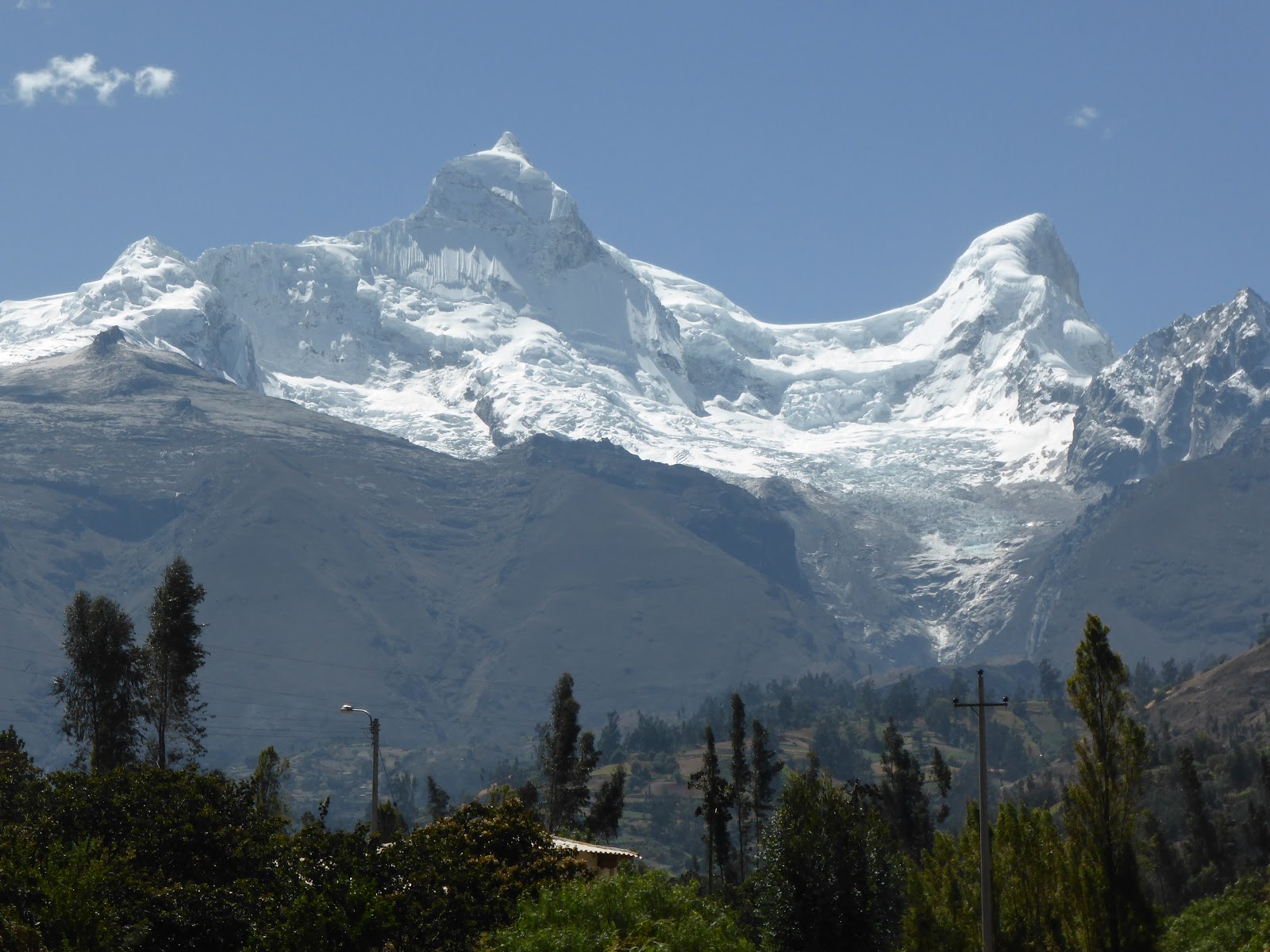
Huascaran the tallest peak in the Peruvian Andes at 6768 metres (22204 feet!)

Along this road was Canon del Pato, reputed to be one of the most dangerous roads in the world, and I decided to see for myself, so continued along the Cordillera, eventually reaching lower peaks with no snow.

Agriculture in the river valley

Farms lining the riverbanks

Panorama

Hydroelectric plant along the river

More of the hydroelectric plant
I eventually reached the start of the Cañón del Pato, and gingerly started along it - though very aware that I would have to return along it to get back to Huaraz for the night.

From a distance it looked pretty harmless

Warning sign at the beginning that it is now a dirt road

Steep drop to Rio Santa

... with evidence of erosion

The road was only wide enough for one vehicle at a time, but there were pull-off places

The first of the 35 one-way tunnels

The tunnels were pretty scary on two wheels - no room to pass, going from bright sunlight into total darkness, despite the headlight, and nowhere to go if something approached from the other side

The road surface was made up of tiny pebbles, like pea shingle, and despite the dirt tyres my bike was skittering about a little 

Looking back the way I had come, showing the steep sides of the canyon

... and the road ahead!
Wooden single track bridge near the start of the Cañón del Pato

After a couple of kilometers I decided that discretion was the better part of valour, and that I should turn back. The road surface was "slippery", the road itself very narrow, the tunnels scary, and I had already met a few vehicles coming towards me, and if I did make it I would have 15 kms back along it (or a much longer detour along dirt roads) to get back. At least I get to brag that I have been on one of "the world's most dangerous roads"!
Retracing my steps back along the main road I was now looking for somewhere to have a bite to eat and found a bakery in Yungay, where I had a pasty and a pastry, and consulted my map. The young lady in the bakery was fascinated by this Gringo biking alone in a remote part of Peru, and was interested in where I was from, and what led me to being in Peru - so I passed my meal chatting with her until customers arrived.
I had read about a mountain lake at the base of Huascaran, Peru's tallest peak, so decided to head for there, and was, in fact, very close to the start of the road - another dirt road! But with the glorious sight of Huascaran in front of me the road was immaterial.
Some of the peaks in the Cordillera range

Huascaran in front of me

I was heading for a lake at the base of the left mountain

I was following a car up the winding dirt road and so as not to eat his dust (I was quicker on the twisty bits but not on the straight ones!) I fell back and stopped to take pictures - this of a farm on the foothills of Huascaran.
Coming round one of the corners I spotted an avalanche on the slopes of Huascaran, but despite a quick stop to grab my camera missed most of it!
All that remained of the avalanche was what looked like smoke at the lower edge of the snow
Climbing higher the vegetation thinned out, but there were still signs of agriculture

At times here you do feel as though you are on top of the world

The approach to the lakes passed through this steep-sided pass

Hard to tell, but I believe the cliffs to be around 2000 metres high!

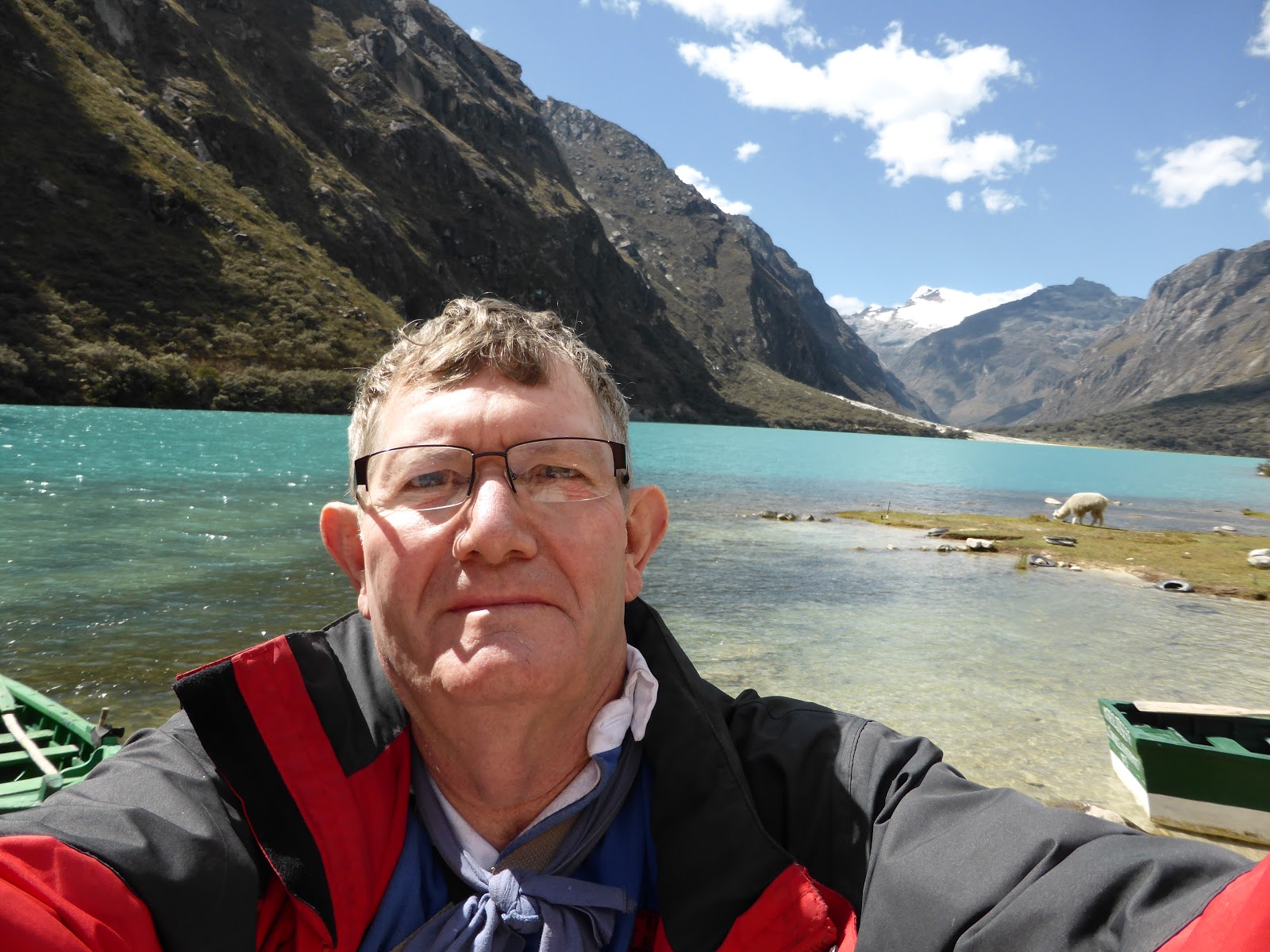
I finally arrived at Laguna de Llanganuco, some 3850 metres above sea level (12600 feet)
The lake is fed by meltwater from the snowy peaks surrounding it, and it was pretty chilly and windy at that altitude!
Boat trips across the crystal waters are popular 
Huascaran towering over the surrounding area


Lonely llama - I think he was there for selfies with the visitors - there were a couple of busloads there while I was visiting

Incredible beauty

Tourist centre - with toilets and places to eat

Peeling bark on a mountain tree


Some of the boats were being painted

Llanganuco is one of a chain of lakes running between the mountains

Although there were other people about it felt as though I had the place to myself

Spectacular - and so tranquil

The surrounding mountainsides looked forbidding


Llama foraging

Another of the tall peaks

Idyllic scene

Lovely place for a selfie, so ...

... rare picture of me!

Huascaran

On the way back - the deep pass we had to go through
The view to the West of the Cordillera

Oli - dwarfed by the mountains
Huashao - small town in the shadow of Huascaran

imagine waking to that every morning!
Looking along the Cordillera Blanca

Coloured sweetcorn drying in the sun

I had to keep stopping to take in the beauty of this area

Looking back down towards Yungay
On May 31, 1970, a 7.9 magnitude earthquake occurred off the coast of Ancash province, Peru, and caused devastation to the town of Yungay. A portion of Huascaran sheered off and the resulting avalanche, which reached speeds of over 320 kph (200 mph), buried the town of Yungay, killing over 20,000 people - the few survivors happened to be at higher ground near the cemetery. The old town was declared a national cemetery and excavation there has been forbidden - with the new town of Yungay being built some 2 kms to the North. 

Campo Santo, Yungay, memorial to the 20,000 killed in the 1970 earthquake.
After possibly one of the best days riding/sightseeing ever (at least on a par with my trip through the Maranon Canyon between Cajamarca and Chachapoyas!) I headed back to Huaraz, though not totally without incident - on a gentle bend the back of my bike stepped out quite seriously, though I managed to retain control, making me wonder if my tyres had finally had enough, but as I had a long ride back in two days it did worry me slightly. The tyres looked to still have plenty of life in them, so I assumed it had just been something on the road surface.
Arriving at the hostel I asked for the keys to take my bike to the secure parking at the rear, but was convinced that it was easier (for them, maybe?) to take it inside the hostel - which meant using a makeshift ramp to get it over the small retaining wall at the kerbside, and manhandling it - with three members of staff assisting - through the front door and into a small courtyard at the rear. We then had to go to the parking anyway to collect my detachable panniers and bring them round as well.